DLP Rules
DLP is the outbound payload scanner: it inspects what an agent is about to send out — tool arguments, API bodies, messages — and catches credentials, PII, and secrets before they leave. Open Policies → DLP Rules.
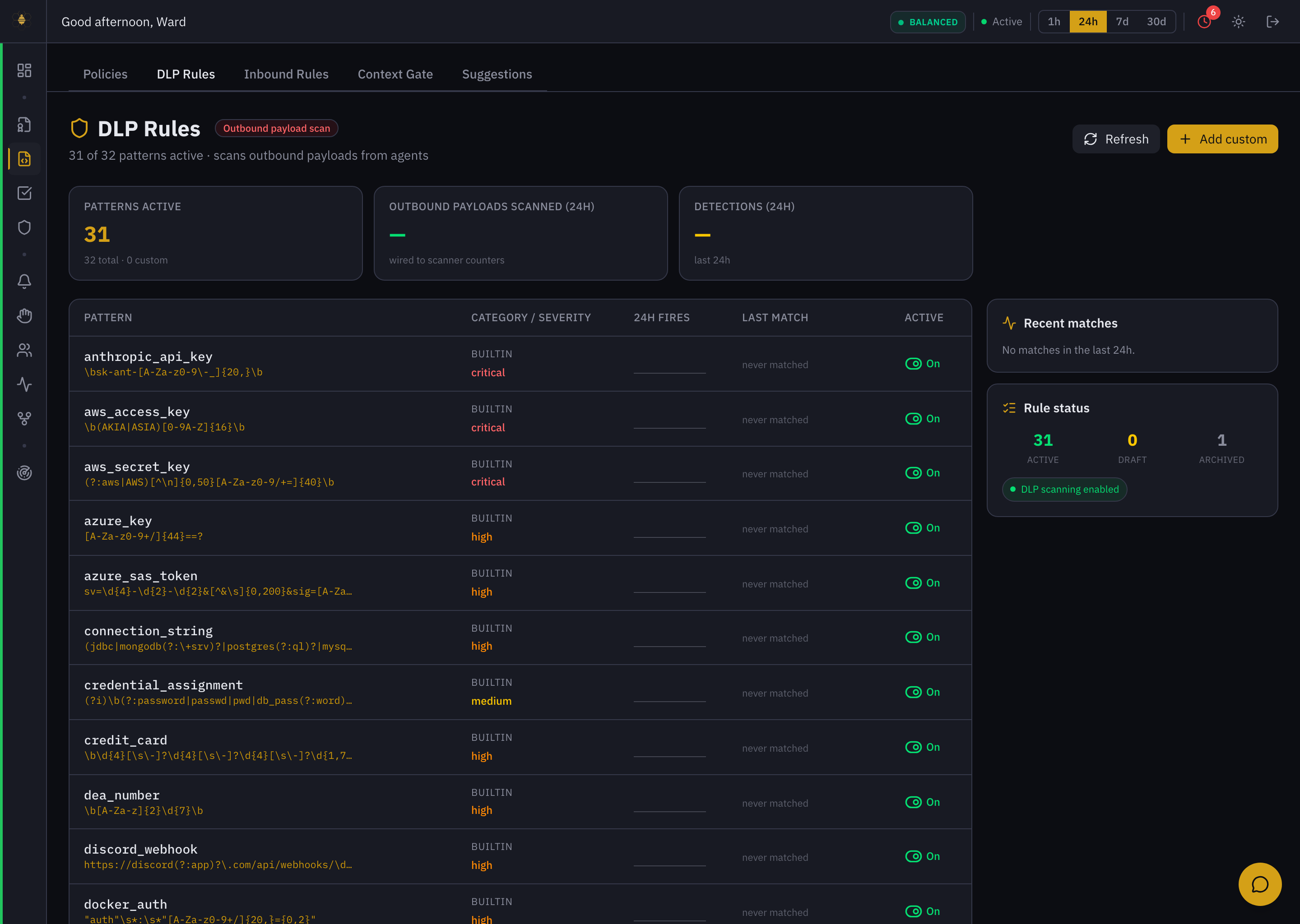 DLP Rules — the built-in pattern library, each with a category, severity, 24h fires, and an on/off toggle.
What it scans
The header shows how many patterns are active (e.g. 31 of 32). Each pattern is a detector with a category (BUILTIN or custom), a severity (critical / high / medium / low), a live 24h fires count, the last match, and an On / Off toggle. The built-in library is broad, covering:
- Cloud & API keys — AWS access/secret keys, GCP service accounts, Azure keys, OpenAI / Anthropic / Google / Stripe / SendGrid / Twilio keys.
- Tokens & credentials — JWTs, GitHub / GitLab tokens, Slack tokens & webhooks, Discord webhooks, connection strings, generic
key=…assignments. - Private keys — RSA / EC / OpenSSH / PGP private-key blocks.
- PII & regulated data — SSN, credit-card numbers, IBAN, email, plus healthcare markers (NPI, DEA, ICD-10).
The stat cards track Patterns Active, Outbound Payloads Scanned (24h), and Detections (24h), and DLP Coverage on the Policies tab summarizes overall strength.
What happens on a match
When a pattern matches, DLP acts on the payload rather than just logging it — the outbound content is redacted (the decision shows as modify in the trace, and only a redacted sample like sk3***xyz is ever stored) or the action is blocked outright, by severity and policy. Every fire lands in the Matched events audit trail on this tab and in the action's Decision Trace.
DLP records the pattern type and a redacted sample — never the raw secret. This is part of why the audit log is safe to retain and export. See Data Protection.
Managing rules
- Toggle any built-in pattern On/Off. (Low-value/noisy patterns like
emailmay be Off by default.) - Add custom — define your own regex pattern with a category and severity, for organization-specific secrets or identifiers.
- Tune severity to control whether a match redacts or blocks.
See DLP Scanner for the detection model, and Integrations & Connectors to enforce on externally-defined sensitivity labels (Microsoft Purview / Cyberhaven) alongside these patterns.