Operational Exposure
Operational Exposure is the risk rollup — "autonomy danger · governance weakness · blast radius", scored by the Behavry Risk Framework. It answers "where is my biggest exposure right now, and what do I do about it?" Open it from the Governance group in the sidebar (labeled Operational Exposure).
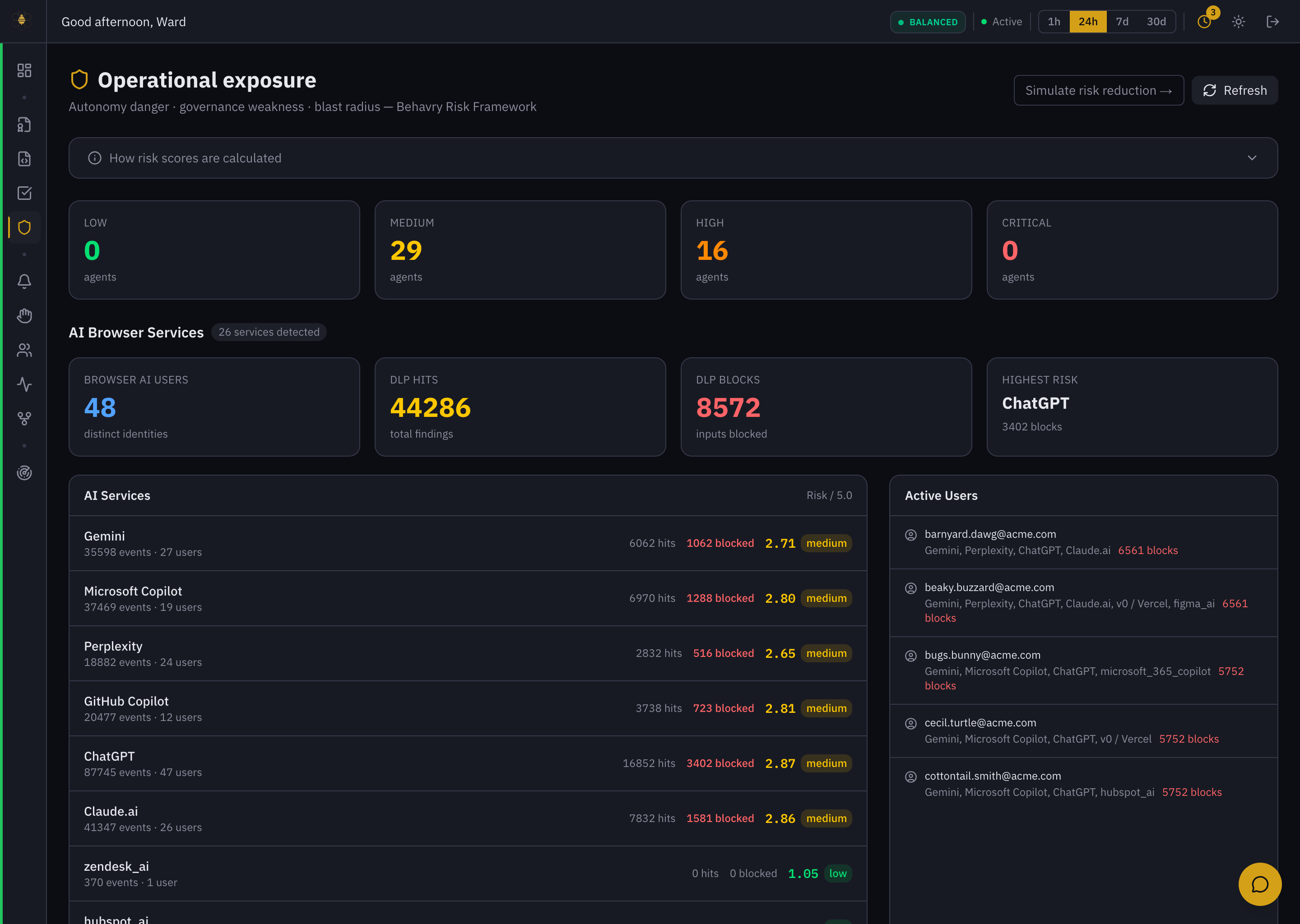 Operational Exposure — agent risk tiers, AI browser-service risk, and the highest-risk services and users.
Agent risk tiers
The top row buckets every agent by risk — Low / Medium / High / Critical. This is the fleet's exposure at a glance: a growing High or Critical count is where to look first. Expand How risk scores are calculated to see the dimensions that feed a score (autonomy, access, blast radius, drift, and more) — the model is explainable, not a black box. See Risk Scoring for the full framework.
Simulate risk reduction lets you model the effect of a change (tightening a policy, quarantining an agent) before you make it.
AI browser-service exposure
Below the agent tiers, Operational Exposure surfaces the AI browser services in use across the org — the human side of AI risk that the browser extension sees:
- Headline counts: Browser AI Users, DLP Hits, DLP Blocks, and the Highest-Risk service.
- The AI Services table ranks each service (ChatGPT, Gemini, Microsoft Copilot, Claude.ai, Perplexity, GitHub Copilot…) by events, users, DLP hits, blocked inputs, and a risk score out of 5.0.
- Active Users lists the people driving that usage and which services they touch.
This is where "who is pasting sensitive data into which AI tool" becomes concrete and rankable.
A triage routine
- Start with the risk tiers — any High/Critical agent is a lead.
- Open the agent (via Agents) and read its risk dimensions to see why it scored high.
- For browser exposure, sort the AI Services table by risk or blocks, and check the Active Users behind the highest-risk service.
- Act — tighten a policy, enroll an ungoverned service (see AI Exposure), or quarantine the agent. Use Simulate risk reduction first to check the impact.
A high activity agent isn't necessarily high risk. The framework weights blast radius — a quiet agent with broad reach and privileged access outranks a busy one that can only read. Chase the score, not the volume.